Cash, Cards, or ACH? How to Choose a Fund Disbursement Method
Cash, gift cards, prepaid cards, or Same-Day ACH? Compare the main ways to distribute funds to families and learn how to choose the right disbursement method for your program.
Every organization that gives money away eventually runs into the same deceptively simple question: what’s the best way to actually get funds into someone’s hands?
It sounds like a logistics detail. It isn’t. The disbursement method you choose shapes how fast help arrives, how much control you keep over where dollars go, how much administrative work lands on your team, and how dignified the experience feels for the person receiving support. Pick the wrong one and you can lose weeks, leak funds to unintended uses, or bury your staff in reconciliation.
This guide breaks down the main ways to distribute funds, the trade-offs of each, and a simple framework for choosing.
Why the disbursement method matters more than you think
A disbursement method is really four decisions bundled together:
- Speed — does money arrive in minutes, days, or weeks?
- Control — can you restrict where and how funds are spent, or is it unrestricted cash?
- Accountability — can you see and prove where every dollar went?
- Experience — is it simple and dignified for the recipient, on any device?
Most traditional methods force you to trade one of these away. The goal is to match the method to the moment instead of defaulting to whatever your finance team has always done.
The main ways to distribute funds
Cash and paper checks
The oldest method, and still common. Cash is universally accepted and requires nothing from the recipient. But it offers zero spending control, no tracking, and real security risk. Checks add a paper trail but are slow to arrive, slow to clear, and assume the recipient has a bank account and a way to deposit them. For any program that needs speed or accountability, cash and checks are usually the fallback, not the plan.
Gift cards
Gift cards feel like an easy answer: buy a stack, hand them out, done. In practice they’re a quiet drain. They’re purchased up front (tying up capital), frequently lost or resold, limited to a single merchant, and nearly impossible to reconcile. If a recipient doesn’t spend the full balance, that money is simply gone—you can’t reclaim it. There’s also no reporting to show a donor how funds were used.
Prepaid and virtual cards with spending controls
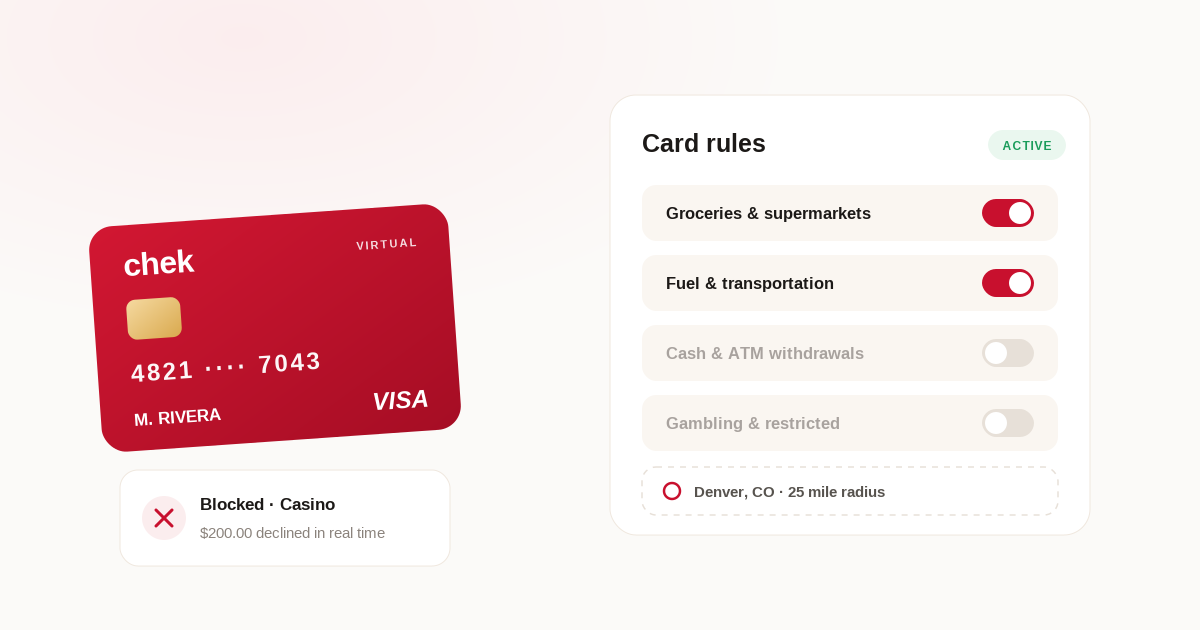
This is where modern disbursement gets interesting. A virtual card can be issued in seconds and configured with real rules: which merchant categories it works at, which geographies, and for how long. Chek Cards let you allow groceries and fuel while blocking cash withdrawals and restricted categories, draw a boundary around a city or region, and set an expiration window.
The result is money that can only be spent as intended, tracked in real time, with unspent balances recoverable. It’s the right tool whenever spending needs guardrails—registration fees, essential needs, place-based relief.
Direct bank transfer (Same-Day ACH)
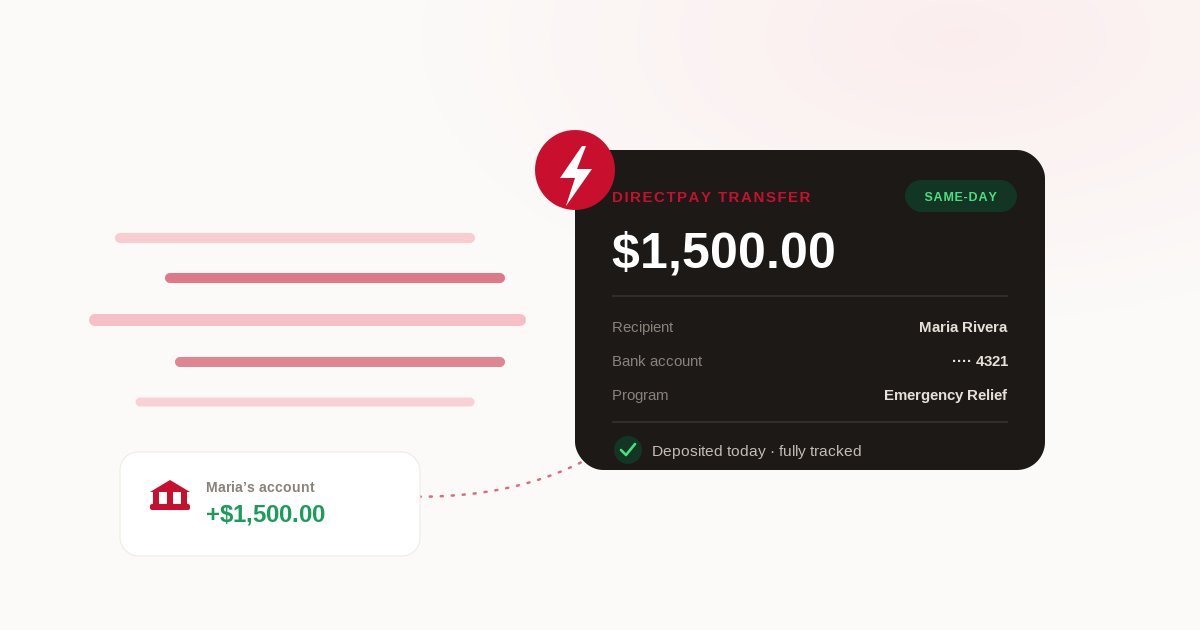
Sometimes people don’t need a card—they need cash in their account to pay rent, a utility, or a bill you can’t predict. DirectPay sends Same-Day ACH straight to a recipient’s bank account. The recipient securely enters their own bank details, you approve the transfer, and funds land the same day, fully recorded.
Direct transfer maximizes flexibility and dignity. The trade-off is that once money is in someone’s account, you can’t restrict how it’s used—so it’s best when unrestricted support is the intent, or when a card simply isn’t a fit.
Digital wallets
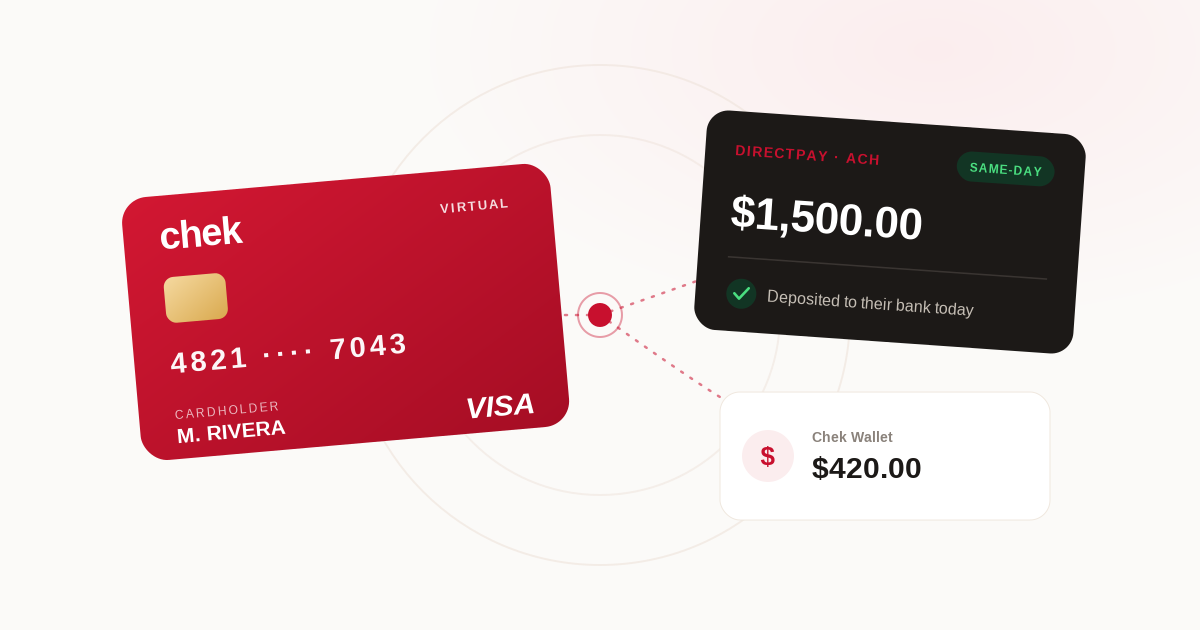
A wallet sits between a card and a bank transfer. Funds land in a recipient’s Chek Wallet and can be sent at any time, with no spending restrictions but full tracking. Wallets are ideal for ongoing, flexible support where you still want every disbursement to roll up into the same reporting.
Side-by-side comparison
| Method | Speed | Spending control | Tracking | Recover unused funds |
|---|---|---|---|---|
| Cash / checks | Slow | None | None | No |
| Gift cards | Medium | Merchant-only | Minimal | No |
| Virtual cards | Instant | Merchant, category, location, time | Real-time | Yes |
| Same-Day ACH | Same day | None (unrestricted) | Full record | No |
| Digital wallet | Instant | None (unrestricted) | Real-time | Varies |
How to choose: five questions to ask
You don’t need a committee to make this call. Run each program through these questions:
- Does spending need guardrails? If funds are meant for specific things—registration, groceries, fuel—use a controlled card. If it’s unrestricted support, a transfer or wallet is simpler.
- How fast does money need to arrive? For emergencies, prioritize instant issuance or Same-Day ACH.
- Do recipients have bank accounts? ACH needs one. Cards and wallets don’t.
- What will you need to report? If donors or funders expect proof of impact, choose a method with real-time tracking and exportable records.
- How much admin can your team absorb? Buying, mailing, and reconciling gift cards or checks is hidden labor. Digital issuance removes most of it.
The best disbursement method isn’t the one you’re used to—it’s the one that matches the speed, control, and accountability each program actually requires.
You don’t have to pick just one
The most common mistake is treating this as a single, permanent decision. A well-run program often uses several methods at once: controlled cards for restricted needs, Same-Day ACH for rent or bills, and wallet transfers for flexible ongoing support.
The key is running them through one platform so every disbursement—regardless of method—rolls up into the same reporting and the same audit trail. That’s what turns a pile of transactions into a story you can tell a donor: dollars in, dollars spent, on-intent, on the record.
When intake, approval, and funding live together, you can also fund the right way per person the moment you approve them—no re-entering data, no switching systems. That’s the idea behind Program Applications: collect once, decide, then issue a card or send a transfer in the same flow.
The takeaway
There’s no single “best” way to distribute funds—there’s the best way for this program, this recipient, this moment. Cash is universal but blind. Gift cards are easy but leaky. Controlled cards give you precision. Same-Day ACH gives you speed and flexibility. Wallets give you ongoing reach.
Match the method to the need, run everything through one accountable system, and you get the thing every mission-driven organization actually wants: help that arrives fast and money you can stand behind.
Want to see how it fits your program? Get in touch and we’ll walk through your disbursement process together.