Spending Controls That Actually Prevent Fund Misuse
Preventing misuse of assistance funds isn't about trust—it's about design. Learn how merchant, category, geographic, and time-based spending controls stop problems before they happen.
Ask a program manager about their biggest fear in handing out money, and you’ll usually hear some version of the same thing: what if it gets spent on the wrong thing?
It’s a fair worry. Misused funds don’t just represent lost dollars—they erode donor confidence, complicate audits, and put your program’s reputation at risk. The traditional response is to hand out money, then chase receipts and hope for the best. That’s slow, invasive, and always after the fact.
There’s a better model: design the funds so misuse can’t happen in the first place. That’s what modern spending controls do.
The problem with “trust and verify”
Most accountability processes are reactive. You disburse funds, then collect receipts, review statements, and follow up on anything that looks off. By the time you catch a problem, the money is already gone—and now you’re spending staff time on investigation instead of impact.
Reactive control also puts the burden on the recipient. Asking someone in a hard moment to save every receipt and justify every purchase isn’t just administrative overhead; it can feel like surveillance. It signals distrust at exactly the moment people need support.
Proactive controls flip the model. Instead of verifying spending after it happens, you define the rules up front and let the system enforce them automatically. Nothing to chase, nothing to prove.
What spending controls actually are
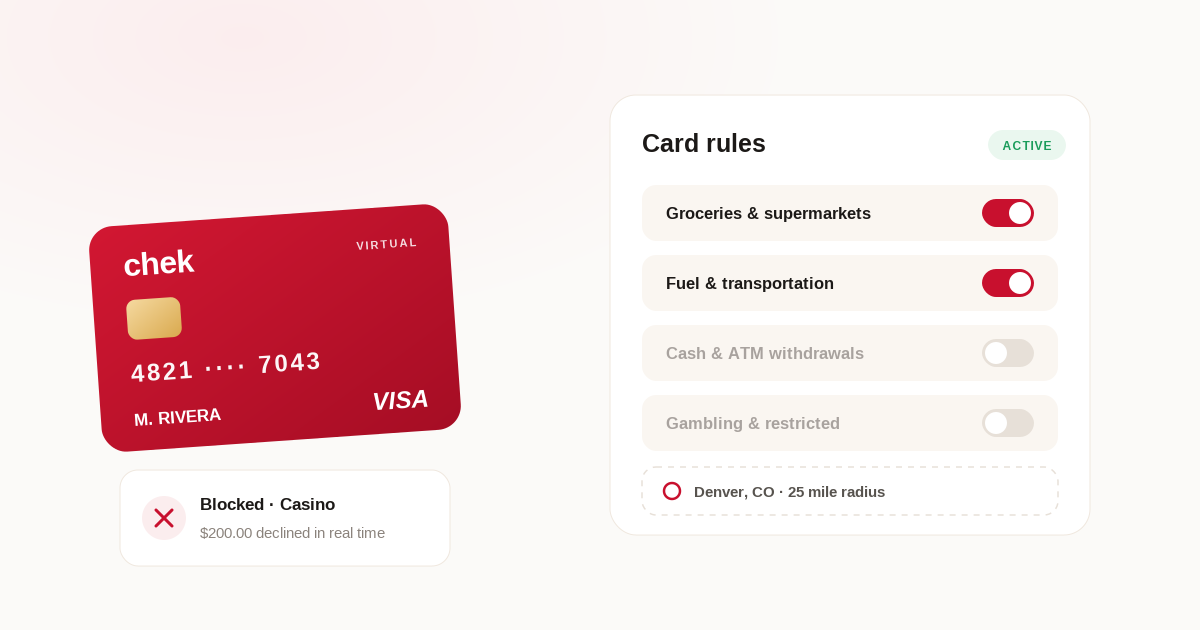
A spending control is a rule attached to funds that determines where, when, and how they can be used. On Chek Cards, you can layer several types of rules on a single card.
Merchant and category rules
The most common control. You choose which merchant categories a card works at—groceries, fuel, medical, childcare—and block everything else. A card meant for registration fees works at the registration merchant and nowhere else. A card for essential needs covers supermarkets and pharmacies but declines at a casino or ATM.
Geographic boundaries
Funds can be restricted to a specific city, state, or radius. For local relief and place-based programs, this keeps dollars in the community they were meant for and adds a strong fraud signal—a transaction 800 miles away simply won’t go through.
Time windows and expirations
You can set when a card becomes active and when it expires. That keeps funds tied to the period your program covers and prevents dormant balances from lingering indefinitely.
Automatic fund recovery
When a card expires with money left on it, that balance doesn’t vanish into the void like an unused gift card—you can automatically reclaim it and redirect it to your mission. Organizations recover an average of 18% of issued funds this way, which is often the difference between serving one more cohort or not.
Prevention beats reconciliation
Here’s the part that changes how programs operate: these rules are enforced in real time, at the moment of purchase. A transaction that falls outside your rules is declined before it ever completes—not flagged in a report you read next month.
That single shift has outsized effects:
- Unauthorized spending is prevented, not discovered.
- Your team stops spending hours reconciling and investigating.
- Recipients get a clean experience—approved purchases just work.
- Donors get proof that their money went where they intended.
The strongest form of accountability isn’t catching misuse after the fact. It’s designing funds so the wrong purchase never goes through in the first place.
Designing controls that respect dignity
Powerful controls can be used well or badly. The goal is to protect funds and treat people with respect. A few principles help:
- Restrict to the purpose, not the person. Base rules on what the program funds—groceries, fuel, registration—rather than assumptions about the recipient.
- Allow generously within the purpose. If the program covers essential needs, don’t nickel-and-dime the category list. Over-restriction creates declines at the checkout line, which is its own kind of indignity.
- Be transparent. Tell recipients what the funds are for and where the card works, so there are no surprises.
- Keep it simple. Recipients shouldn’t need an app or an account. A card that works on any device, with clear rules, is easier for everyone.
Well-designed controls fade into the background. The recipient buys what they need, it works, and no one has to have an awkward conversation about a receipt.
How controls build donor trust
Spending controls don’t just prevent problems—they generate the data that earns future support. Because every transaction is captured with amount, merchant, category, and time, you get real-time reporting you can share with the funders who make the work possible.
That transparency compounds. A donor who can see that 99% of their contribution was spent on-intent is a donor who gives again—and gives more. Accountability, done right, is a growth engine, not a compliance chore.
Getting started
You don’t need to overhaul everything at once. Pick one program with a clear purpose—say, a registration-fee subsidy or an essential-needs fund—and define three things:
- The categories funds should and shouldn’t work at.
- The geography, if the program is local.
- The time window the funds should cover.
Issue a controlled card against those rules, watch the real-time transactions come in, and compare the experience to your current receipt-chasing process. Most teams don’t go back.
If you’re weighing controlled cards against unrestricted transfers for different parts of your program, our guide to choosing a disbursement method walks through when each makes sense. And if you have questions specific to your program, get in touch—we’re happy to help you design controls that fit.